Team & Remote Meetings
Wheel of Names for Daily Standups: A Team Guide
Most teams default to an implicit standup order and never question it. A random-order wheel removes that pattern in the time it takes to click spin.
Key takeaways
- Scrum's own guidance timeboxes the daily standup to 15 minutes precisely so it stays a quick sync, not a status meeting, and anything that adds friction to that timebox works against the format.
- A 2025 peer-reviewed study in the European Journal of Work and Organizational Psychology found stand-up benefits are closely tied to psychological safety; a visibly random, unbiased selection method removes one small, avoidable source of the "why am I always last" friction.
- Not every team should keep a synchronous standup at all: teams spanning many time zones increasingly move to async written updates, where speaking order stops being a question.
- The wheelofnames.io team generator wheel handles the randomization in seconds; it doesn't replace the standup itself, just the "who goes first" decision inside it.
Why standup order quietly matters
The Scrum Alliance and Atlassian both describe the daily standup the same way: a strict 15-minute timebox, team-owned, built around three questions.
What did you do yesterday, what will you do today, are there blockers. Nothing in that format specifies order.
Teams pick one by default (alphabetical, seat position, join date) and then never revisit it.
So the same structural quirk repeats every working day for as long as the team exists.
A 2025 study published in the European Journal of Work and Organizational Psychology looked specifically at daily stand-up meetings, work satisfaction, and psychological safety.
It found stand-ups' actual benefits depend heavily on how safe people feel contributing, not just on running the ritual itself.
A visibly random draw is a small, concrete way to remove one source of unfairness perception (always going last, always being rushed) without adding a single minute to the timebox.
Step 1: Set up a standup rotation wheel
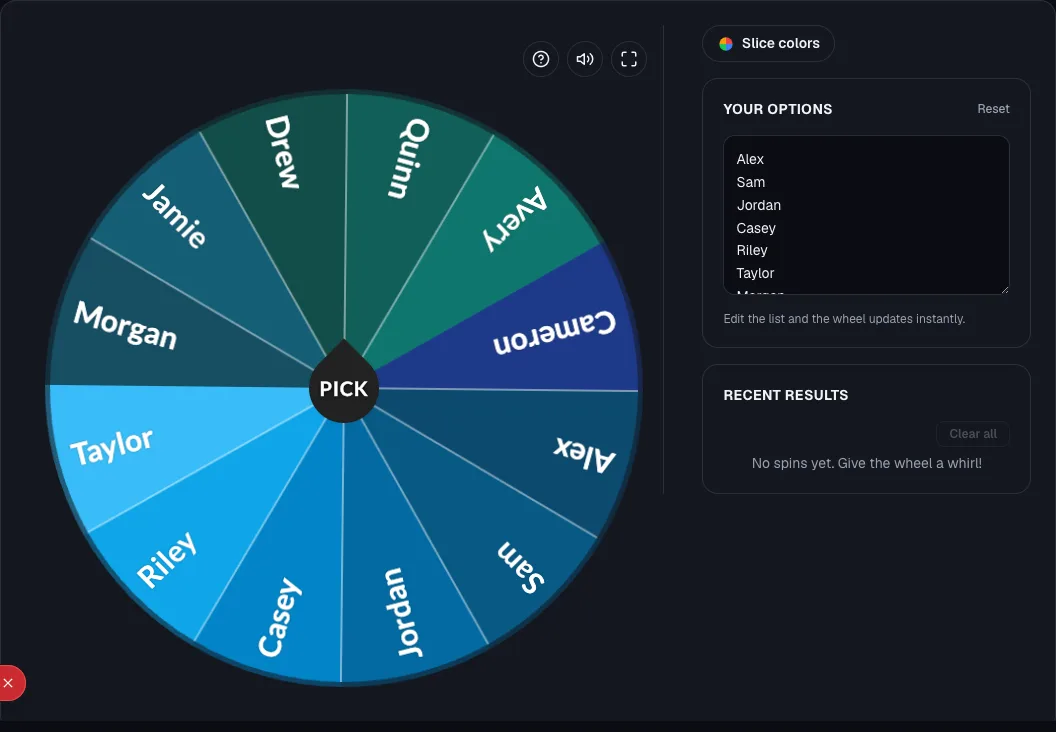
Add your team's names to a team generator wheel and save it. Keep this roster updated as team membership changes rather than manually adjusting order in your head each morning.
For async, hybrid, or video-call standups specifically, see wheel of names on Zoom meetings for the screen-share setup.
Step 2: Spin at the start of standup
Spin once, right as standup starts, and go in the order the wheel produced. This takes seconds and removes any perception that order reflects hierarchy or favoritism.
Nobody can argue the pick was rigged when the whole team watched it happen.
Variations for common team situations
- Someone's on PTO or out sick: remove them from that day's spin rather than spinning with a name that won't be used.
- The same person keeps going first two days running: a plain wheel gives every name equal odds each spin and doesn't track history, so pure randomness can repeat someone. If that visibly bothers the team, a simple manual rule (skip yesterday's first-picker from today's spin) is easier than trying to force the tool to self-balance.
- Hybrid teams: spin during the synchronous portion of standup and post the resulting order in chat for context, even though order itself matters less once part of the update becomes written.
When a wheel isn't the fix: the async alternative
Not every distributed team should keep a synchronous daily standup at all.
Multiple 2025 write-ups on remote-team practice (from async-tooling vendors like Parabol and Catapult Labs) converge on the same tradeoff.
Async written standups, where each person posts their update on their own schedule instead of live, remove the timezone penalty entirely for teams spread across many regions.
They also tend to produce more precise updates because people write rather than perform them out loud.
The tradeoff is losing the ability to react to a blocker in the moment.
Someone has to actively read and respond to an async post instead of just hearing it live.
If your team is genuinely global, moving to async removes the "who goes first" question by design: there's no order because there's no shared live moment.
If your team is co-located or overlaps enough hours to make a synchronous standup worth keeping, randomizing order is the lighter-touch fix.
It solves the fairness problem without giving up the format.
When NOT to randomize
Randomizing standup order is a light-touch fix for a light-touch problem. Skip it if:
- Your team's standup already rotates fairly through some other system that works.
- The team explicitly prefers a fixed order for a specific reason, such as dependencies where one person's update sets up the next.
- Your standups are already tightly run under 5 minutes; the spin itself shouldn't be the thing that adds friction to a format built around removing friction.
Ready to try it yourself?
Open the toolFrequently asked questions
- Should the standup facilitator/scrum master control the spin, or anyone?
Either works. Some teams rotate who controls the spin as its own small randomized task; others keep it with the facilitator for consistency.
- Does this work for standups with more than 10-12 people?
Yes, though very large standups (15+) are usually a sign the meeting itself needs restructuring.
Scrum's own guidance assumes a small team size, and a wheel can't fix a standup that's grown past the format it was designed for.
- Can I use the same wheel for other team-related picks, like task assignment?
Yes. See the random team picker wheel guide for other ways teams use the same tool beyond speaking order.
Sources
- Scrum Alliance: What Is the Daily Scrum? A Guide to the Daily Event
- Atlassian: Standups for agile teams
- European Journal of Work and Organizational Psychology, 2025: daily stand-ups, work satisfaction, and psychological safety
- Parabol: Virtual vs Async Standups, Which Is Right for Your Team?
- Catapult Labs: Async Standups, The Complete Guide for Remote Teams