Raffles & Giveaways
Picking a Giveaway Winner Fairly: Step-by-Step
Most giveaway complaints aren't actually about the spin. They're about the entry list. Here's how to get both halves right.
Key takeaways
- Fairness is a process, not just a randomization claim: collect entries consistently across every channel, lock the list before drawing, and spin visibly.
- The FTC's 2026 enforcement focus has sharpened on giveaways with unclear disclosures and on influencer-promoted giveaways that blur organic content with compensated promotion. Plan your disclosure language before you launch, not after.
- Protect participant privacy when announcing: use a first name plus last initial, a handle, or an entry/ticket number instead of full contact details, unless the winner has agreed otherwise.
- Save your eligible-entry list and a proof-of-draw record for at least 90 days. Disputes happen, and having a timestamped record ends them quickly.
Why "how you picked the winner" matters more than people expect
A giveaway with a genuinely random draw can still look rigged if the process behind it was invisible.
Conversely, a giveaway can look completely trustworthy even with a simple free tool, as long as participants can see how entries were collected and how the winner was chosen.
The gap between those two outcomes is entirely about transparency, not technology.
Step 1: Lock the entry list before drawing
- Set a clear entry deadline and stop accepting entries at that time. Don't quietly extend it, even by a few minutes, if anyone is watching the clock.
- If entries came from multiple sources (comments, email signups, in-store forms), merge them into one list and dedupe by a consistent identifier (email address, handle, or full name) so the same person doesn't get counted twice across channels.
- Save a copy of the raw entry list separately from the picker tool itself, so you have a record independent of the draw. This matters more than it sounds: if a dispute arises weeks later, "here's the exact list we drew from, timestamped before the spin" ends the conversation immediately.
Step 2: Disclose properly before you launch (not just at announcement)
If your giveaway runs on social media, current platform and FTC guidance is specific about what needs to be visible before someone enters.
It shouldn't be buried in a caption or hashtag wall:
- State clearly that no purchase is necessary to enter or win, if that's true. This is the standard language ("NO PURCHASE NECESSARY TO ENTER OR WIN") that separates a legal sweepstakes from what regulators would otherwise treat as an illegal lottery in most US jurisdictions.
- Disclose eligibility, entry method, prize value, and the winner-selection process on the post or page itself. Platform guidance for TikTok and YouTube in 2026 specifically calls out that this needs to be visible on the content, not just in a linked terms page.
- If an influencer or paid partner is running the giveaway, disclose the material connection per FTC endorsement guidance; audiences should know if someone was compensated to promote it.
- Add the standard platform disclaimer if you're running on Instagram, Facebook, or a platform with promotion guidelines (e.g., "This giveaway is in no way sponsored, endorsed, or administered by, or associated with, Instagram").
Step 3: Choose and set up your picker
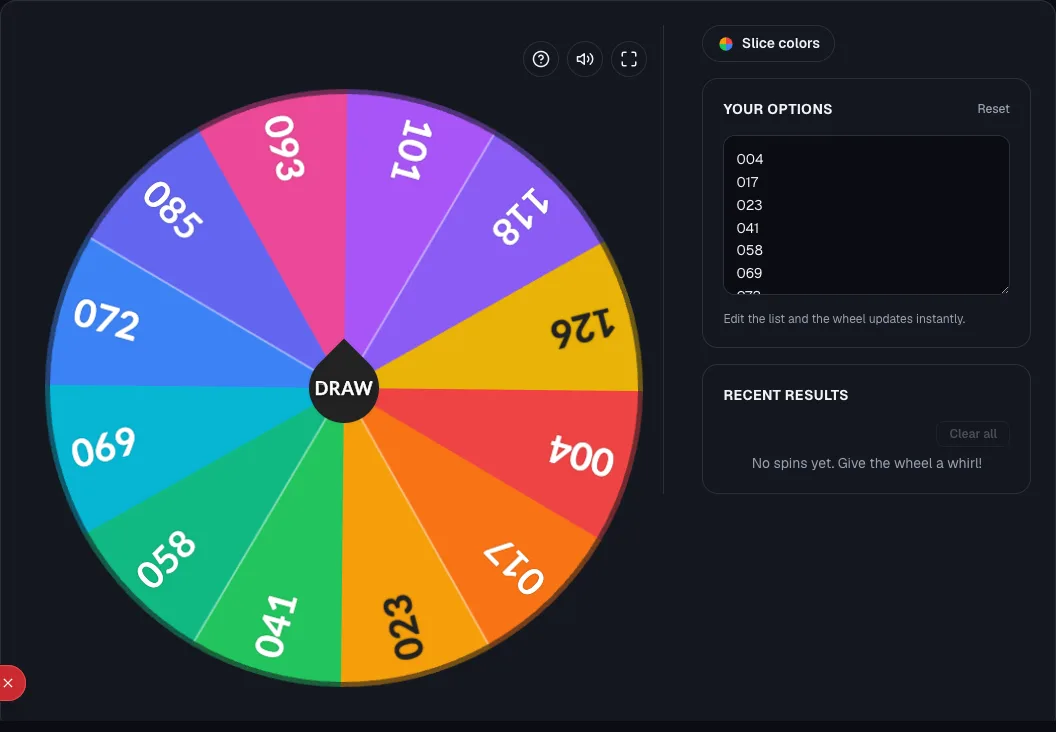
Paste the final, deduped entry list into a giveaway wheel.
Using a dedicated, visible wheel, rather than manually "eyeballing" a winner or running an off-screen script, is the single biggest thing that makes a giveaway feel fair.
Participants watching can see the exact pool the winner came from.
For giveaways with more than a couple hundred entries, check whether your picker handles list import cleanly (CSV or paste) and whether it has an elimination mode for multiple winners.
See our comparison of random winner generator wheels for which tools handle this well.
Most dedicated pickers support removing a winner from the pool automatically so the same person can't win twice.
Step 4: Spin publicly
- For social media giveaways, spin on camera or on a screen-recorded video and post it unedited: this is the single most effective way to pre-empt "was this rigged?" comments, and it costs nothing beyond the 30 seconds it takes to hit record.
- For internal or company giveaways, spin during a meeting or all-hands so it's witnessed live, rather than announced after the fact with no visible process behind it.
- Spin once. Re-spinning because a result "doesn't feel right" is exactly the behavior that turns a fair process into a disputed one. See the common mistakes below.
Step 5: Announce without oversharing
- Use a privacy-safe identifier by default: "Sarah M." or "@handle" instead of a full name and contact info, unless the winner has explicitly agreed to a full public announcement.
- Contact the winner privately first to confirm they're comfortable being named publicly and to arrange prize delivery, then post the public announcement.
- If the winner doesn't respond within your stated timeframe, follow your own published rules for re-drawing rather than making an ad hoc call in the moment. This is exactly why Step 2's disclosure step matters even for casual giveaways.
Common mistakes that make a giveaway look unfair (even when it isn't)
- Re-spinning "because that name doesn't seem right." Once you spin, that result is final, or you undermine trust in every giveaway you run afterward, including future ones.
- Not stating the total entry count anywhere, leaving people to guess whether the pool was 40 people or 40,000.
- Picking a winner off-platform with no visible process at all, even when the actual selection genuinely was random. Audiences can't distinguish "random but invisible" from "not random," so treat visibility as part of the fairness, not a nice-to-have.
- Skipping the "no purchase necessary" disclosure when a purchase requirement exists anywhere near the entry flow: this is a common and avoidable compliance gap, not just an optics problem.
Ready to try it yourself?
Open the toolFrequently asked questions
- Do I need to publish the full entry list?
Not for most casual giveaways, but stating the total entry count ("1,240 entries, 1 winner") builds trust without exposing individual participants' data.
- What if a winner doesn't respond to claim the prize?
State a claim deadline in your published rules up front (48 hours is common), and re-draw only according to that stated rule. Don't improvise after the fact.
- Is a livestreamed spin necessary for small, informal giveaways?
No, for a small friend group or a low-stakes internal team giveaway, a simple screen share or a follow-up screenshot of the result is usually enough.
- How long should I keep giveaway records?
General industry guidance for social media promotions suggests keeping the eligible-entry list and proof-of-draw for at least 90 days after the giveaway closes.
That covers you in case a dispute or platform review comes up later.
- Does this apply the same way to a workplace or classroom giveaway?
The core fairness principles (visible entries, transparent draw, documented result) apply everywhere.
The disclosure and legal-compliance steps in Step 2 are specifically about public, promotional giveaways; an internal team raffle for a gift card doesn't need FTC-style disclosures, just a fair process.
Sources
- Social Media Rules for Giveaways (KickoffLabs)
- Instagram Giveaway Rules in 2026 (KickoffLabs)
- Instagram Giveaway Rules: The 4 That Get Posts Removed (2026)
- YouTube Giveaway Rules Checklist (2026)