Raffles & Giveaways
How to Run a Fair Raffle with Wheel of Names
Running a raffle sounds simple until someone loses and asks how the winner was really chosen. Here's how to set one up so nobody has grounds to question it.
Key takeaways
- A fair raffle needs three things: a visible entry list, a transparent draw mechanism, and a documented result, not just a spin.
- Modern browser-based pickers generate randomness with the Web Crypto API's crypto.getRandomValues() rather than Math.random(), which is the current baseline for trustworthy client-side randomization.
- Weighting entries (3 tickets = 3x the odds) should be done with a native weight field where the tool supports it, not by pasting the same name repeatedly; that clutters the visible wheel and makes the entry count harder to verify at a glance.
- Screen-recording or screen-sharing the live draw is the cheapest, most convincing proof of fairness you can produce, and it costs nothing.
What makes a raffle "fair"
Fairness isn't only about the randomness happening under the hood: it's about whether participants can verify the process themselves. Three things need to hold:
- The entry list is visible before the draw. Everyone should be able to see, or have already seen, exactly who's in the pool. A raffle where entries are added or edited after the draw starts isn't fair, no matter how random the selection mechanism is.
- The selection mechanism is genuinely random and can't be adjusted mid-draw. A spinning wheel is a good choice specifically because it's difficult to fake convincingly on camera. A tool that just prints a result to a text box asks for more blind trust than most audiences are willing to give away for free.
- The result is recorded. A raffle with no record of who won, when, and from what list is a raffle nobody outside the room can verify after the fact.
Step 1: Collect and clean your entry list
Gather participant names or ticket numbers in one place before you touch the wheel.
- Remove duplicates unless your raffle explicitly allows multiple entries per person.
- Decide up front how you'll handle multiple tickets per person (see the weighting section below) and state that rule publicly before the draw, not after.
- Double-check spelling against your original entry source (signup form, spreadsheet, ticket log) so the announced winner matches a real, verifiable person.
Step 2: Set up the wheel and weight tickets correctly
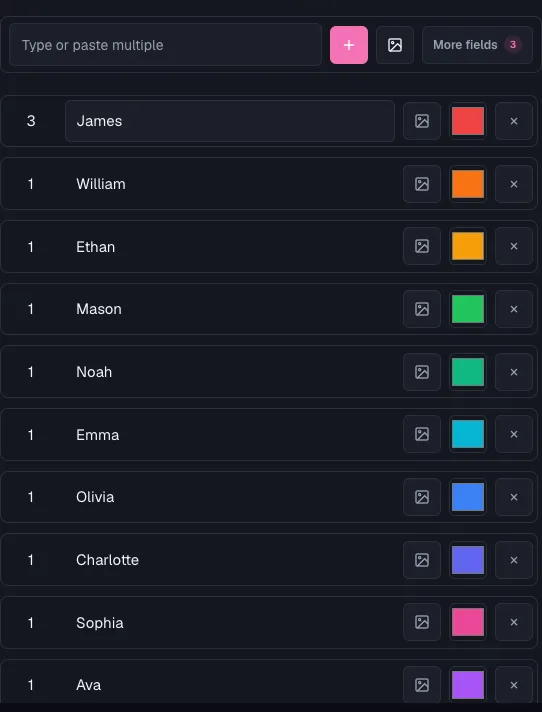
Open the raffle wheel and add one entry per line, either typed directly or pasted from a spreadsheet.
It's designed around drawing tickets or entrants for this kind of prize draw. That signals to participants you're using a process meant for the job, not a generic list picker.
If your raffle sells tickets, where buying 3 tickets should give 3x the odds of buying 1, use the weight field in the [full editor on the homepage](/).
That beats defaulting to pasting the same name three times. The purpose-built raffle wheel page itself keeps things simple and doesn't expose per-entry weight.
Several competing tools, Picker Wheel and Uplup among them, support the same kind of per-entry weighting.
If you'd rather not use weighting at all, using ticket numbers as the entries themselves (e.g., "Ticket #001" through "Ticket #250") is the next best option.
It keeps names private until a number is drawn, which matters for public or large-scale raffles, and makes ticket-based odds visually obvious without duplicate name spam.
Step 3: Run the draw live
This is the step most raffles skip, and it's the one that actually builds trust:
- In person: spin in front of the group, on a screen everyone can see.
- Remote or online: screen-share the wheel during a livestream, video call, or scheduled event so people watch the spin happen in real time against the entry list they can see. Several competing raffle tools explicitly support this. One, GoSpinWheel, advertises native screen-sharing compatibility for Zoom/Teams draws, and streamer-facing tools add OBS green-screen modes for the same reason: a live audience watching the actual spin is the strongest fairness signal available.
- If a live audience isn't available, record it. Post the unedited clip alongside your announcement. A 15-second screen recording showing the full wheel, the spin, and the landing pre-empts almost every "was this rigged?" question you'd otherwise get in the comments.
- Don't pre-spin with the real entry list "to test it" in front of participants. Test with placeholder names beforehand, then load the real list only for the actual draw. And don't re-spin because you dislike the result; only redraw if your published rules explicitly allowed for it in advance (e.g., "we will redraw if the winner is unreachable within 48 hours").
Step 4: Announce and document the winner
Once the wheel lands, record:
- The full entry list used for that specific draw
- The date and time of the draw
- The winning entry
- A link to the recording, if you made one
A note on legal and etiquette requirements
This section is general guidance, not legal advice. Raffle, sweepstakes, and lottery rules vary by country and, within the US, by state.
Some jurisdictions require registration or bonding for raffles above certain prize values, especially for nonprofits and paid-entry raffles.
A free, no-purchase raffle among friends, a classroom, or a small team has essentially no legal exposure in most places.
The moment money changes hands, paid tickets or a purchase requirement, or a business runs the promotion publicly, it's worth checking your local rules.
KickoffLabs' state-by-state overview is a reasonable starting point. Keep this documentation for at least a few weeks after the prize is delivered in case of a dispute.
If your raffle involves any kind of public promotion (social media, a business giveaway, a paid entry), pair this process with written rules published before you launch.
Our raffle contest rules guide has a copy-paste checklist for exactly that.
Ready to try it yourself?
Open the toolFrequently asked questions
- Do I need special software to run a fair raffle?
No. A free browser-based wheel is enough for the vast majority of raffles.
What matters more than the software is the process: a visible entry list, a live or recorded draw, and a documented result.
- Does the wheel guarantee a truly random result?
Modern browser-based pickers generate randomness client-side using the Web Crypto API's crypto.getRandomValues(), the current standard for trustworthy in-browser randomization (as opposed to older Math.random()-based implementations).
That's a solid fairness baseline for casual and most business raffles.
For high-value, publicly scrutinized draws, pair it with a documented process (recording, published rules, a visible entry list) rather than relying on the randomness claim alone.
- How do I handle a raffle with hundreds or thousands of entries?
Use list or CSV import if your picker supports it, and consider using ticket numbers instead of full names so the visible wheel stays legible at scale.
For very large public raffles, tools that log an audit trail (pool size, draw timestamp, a hash of the selection) add an extra layer of proof.
This is increasingly common among dedicated raffle-picker products, several of which now offer downloadable proof certificates as a paid feature.
- What if two people dispute who was actually entered?
This is exactly what documenting the entry list before the draw prevents.
Keep a timestamped copy (a screenshot or a saved wheel link) from before you spin, not just the announced result.
- Can I re-spin if I don't like the result?
Only if your rules said so before the draw.
Re-spinning because you personally dislike the outcome is the fastest way to make a fair raffle look rigged, even when it wasn't.
Sources
- MDN: Crypto.getRandomValues()
- Contest, Giveaway, or Sweepstakes Laws By State (KickoffLabs)